Thursday, September 19, 2024

Jennason Newsletter 2024

Valued Jennason Customers and Colleagues-

As we enter a critical phase in pharma serialization, I wanted to provide a few updates on Jennason’s consulting services and solution offerings.

The theme over the coming months and into 2025 is “for the first time” as the pharma industry enters uncharted territory with the final milestone of DSCSA set to go into effect in November.

To put it simply- “for the first time” C-level executives will start getting phone calls about product supply distributions, and the associated financial consequences, due to serialization issues.  The companies which recognize and address this momentous shift will be best positioned to avoid these operational and financial risks.

Towards that end, we are excited to announce the upcoming release of Jennason DASH.   DASH is positioned to be an indispensable tool for a manufacturer’s daily management of DSCSA operations.  More information can be found below in the ‘Solution Updates’ section.

State of the Industry:

  • For the past 10+ years the industry has worked to implement serialization systems and processes, but “for the first time” are operating in a mode where these systems and processes MUST work in order to avoid supply distribution. The function, usability and customer support of serialization systems is being tested. (and the results are often not positive)
  • State agencies are widely distributing targeted DSCSA audits.  This means many companies “for the first time” have to show evidence of documented DSCSA processes including product verifications/requests for information, suspect & illegitimate product handling, waivers & exceptions management and authorized trading partner management.
  • The industry’s lack of standardization and progress towards implementing efficient DSCSA exception handling means companies “for the first time” will be faced with resourcing needs to manage DSCSA operations on a daily basis that exceeds internal capacity.    


Consulting Updates and Outlook

Jennason consulting services continue to focus in three main areas:

  • Supporting manufacturers in development of their daily DSCSA operations management procedures.  Jennason clients are on the leading edge of exception identification and resolution- ensuring the risk and financial impact due to supply disruption (rejected/returned shipments) are minimized.  Two key lessons learned:
    • Your serialization vendor plays a major role in your ability to define and execute efficient DSCSA daily operations.   Many companies are now feeling the pain as vendor capabilities fall short in three main areas:   System usability, access to data and customer support.   With the expectation that DSCSA exceptions are resolved as soon as possible, having to wait a week for your vendor’s customer support to respond is unsustainable.
    • Relying on human/manual effort alone cannot scale to the levels of efficiency most manufacturers need.   Managing and resolving exceptions through technology is the only feasible answer.  Jennason has the solutions. (See more below)
  • Executing DSCSA compliance assessments including mock audits, simulation sessions, compliance gap identification and recommended mitigations.   Jennason has developed a 40-point DSCSA compliance checklist for manufacturers to ensure line-by-line compliance with all applicable requirements.  Additionally, Jennason has authored SOP templates that are leveraged by clients to quickly mitigate documentation gaps.   Jennason clients who have gone through a DSCSA compliance assessment are positioned to confidently respond to audits.
  • Supporting emerging pharma and biotechs as part of commercial launch activities. Companies who are preparing for their first commercial product will now be launching into an environment that requires full serialization compliance from 'Day 1'.  No longer can companies only plan to have serialization systems and packaging/distribution connections in place for launch, now all process documentation must be effective as well as connectivity with all downstream customers.  The result has been a notable shift during vendor selection evaluations- as the focus is now on system usability, exceptions management and customer support.  Jennason continues to help pre-commercial organizations through serialization education, planning, vendor selection and implementation.


Solution Updates

Jennason continues to provide leading implementation aides and operational solutions to the industry.    The Serialization Test Tool maintains its position as the industry’s only serialization-specific test data simulator- capable of simulating batch packaging, shipments/receipts and end of life scenarios without the costly dependencies on packaging, distribution and trading partners.  (https://jennason.com/solutions)

We are also excited to announce the launch of the most comprehensive and integral solution that Jennason has brought to market to date:  Jennason DASH

Jennason DASH fills a significant gap in providing real-time visibility into daily DSCSA compliance operations.   DASH serves as the centralized point for manufacturers to monitor business critical serialization activities including:

  • Real-time reconciliation monitoring:   DASH is the industry’s only solution which incorporates batch and shipment source data from electronic batch records, ERP and packaging/ distribution partners and compares against your serialization data.  With DASH, companies identify mismatches between source and serialization data for every batch and every outbound shipment to customers- including reconciliation of each shipment line item to ensure the associated DSCSA T2 reflects the right product, lot, expiry and quantity of SNs.   Customers are immediately notified of reconciliation issues- often prior to the physical product arriving at the customer- thus giving DASH users valuable time to resolve exceptions before it impacts product supply.  
  • Exceptions Management: Reconciliation failures as well as exceptions communicated by trading partners are managed by DASH through to resolution.  DASH directs users through the necessary resolution steps based on the nature of the exception and the trading partner(s) involved.  Moreover, when integrated with select serialization vendors, DASH can automate resolution actions including data corrections.
  • Inquiry and Investigation Record Management: DASH provides a repository and workflows for carrying out required DSCSA processes including product verifications, requests for information/product tracing requests and trading partner/FDA notifications.   Product verifications and product tracing requests can be performed directly in DASH, including the gathering of required response evidence and the automation of response communications back to the requestor.   When needed, DASH also provides workflows for carrying out suspect product investigations and associated illegitimate product actions including Form 3911 generation and the retention of sampling and disposition records.
  • Supply and Trading Partner Management:  DASH allows companies to manage the onboarding and ongoing support of supply partners (Packaging/CMO/Distribution/3PL) and trading partners.   These features integrate with Jennason’s Pharma CollabNet Master Data repository which maintains location and contact master data for thousands of industry entities.  Direct access to Jennason Pharma CollabNet eliminates the need for inefficient master data exchange and streamlines the onboarding processes.


As always please feel free to reach out anytime with questions/comments.  Have a great end to 2024!!

Scott Pugh

Principal

Scott.pugh@jennason.com


Wednesday, March 27, 2024

It's time to get honest about VRS (in its current form)


The recent events-   a large volume of verification requests were sent out originating from a GLN that doesn’t resolve to a known entity (Per GS1’s ‘Verified by GS1’) nor provided any other identifiable means to determine who the requestor was- not even a company name was provided.  

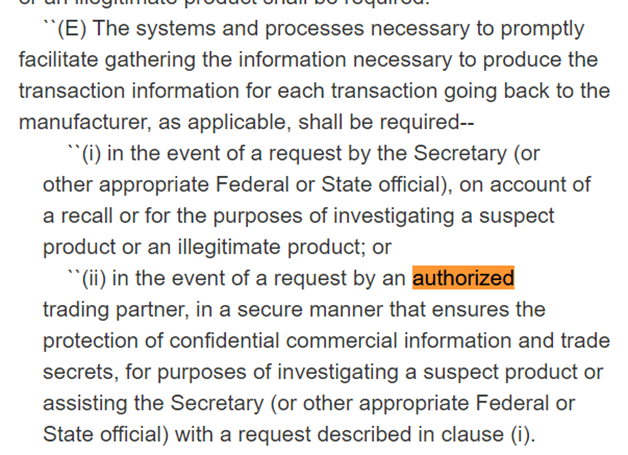
The compliance gap centers on the DSCSA requirement that entities are to only respond to verification requests from ‘authorized’ partners.   Here are the relevant clauses


For companies who DON’T have VRS they may have received these verification requests via email or other means- which allowed them to (hopefully) act per SOPs and NOT respond as there was no feasible way to ensure the requestor’s ‘authorized’ status as required by DSCSA.

For companies who DO have VRS, most (if not all) automatically responded to the requests- Putting them directly out of compliance with DSCSA for the reasons noted above.

Again you read that correctly-  companies who received these requests and DIDN’T have VRS had more control to ensure their compliance with DSCSA compared to companies who DID have VRS.

What the recent experiences highlight is the lack of control within the VRS framework and within VRS vendor solutions to guarantee that responses are returned to ‘authorized’ requestors .   In this situation an organization simply had access to a VRS interface and was able to enter serial numbers which triggered the requests. Even worse is the current understanding is that this organization didn’t even have physical possession of the items.    Thank goodness it doesn’t appear this was a ‘rogue’ organization or bad actor- but what’s stopping that from happening in the future?   

Having access to a ‘system’ that can tell me what serial numbers are legitimate and which are not is a counterfeiters utopia and undermines the entire concept of VRS and DSCSA

“…But Scott credentialing solves all of this”   Eh not so fast-   Credentialing ‘could’ solve all of this … but only if credentialing becomes a requirement across the whole industry- which is a pipedream unless congress wants to amend that into DSCSA.

I’ve covered this topic before- we can’t even get every entity to pay $30 for a GLN, there is no chance that every entity goes out and gets credentials unless they are forced to.   Until then- credentialing has limited benefit.     If I’m a manufacturer and could flip a switch in my VRS solution that says only respond to credentialed requests- I’d be blocking nearly every verification request that comes in.  Which brings us back full circle to my original statement-  Why even have VRS enabled at this point?

Make no mistake- I’m the technology guy.  I’m the one harping that the only way serialization/traceability works in pharma is if we build and implement better technology compared to what we have today.  I’m not saying automated verification requests should go away-  we just have to find a way that actually benefits the industry and not just solution provider’s checkbooks.

Put VRS in its current form out to pasture, go back to the drawing board and realize that automated verifications is just another use case that requires true collaboration networks to be implemented in this space.

Thursday, October 5, 2023

The email every company should send to their serialization vendor today

[Serialization Vendor]-

We are planning out serialization activities for 2024 and had a few questions to help us put some estimates in place.  Appreciate your help.

  1. What is [vendor]’s involvement in ongoing initiatives to improve interoperability across the industry- such as the NABP Pulse partner program?
  2. We are hoping to automate serialization testing activities where possible so that we can reduce our dependency on partners being involved (in every case) and/or having to manually create test data ourselves.   What options can you provide for automating testing activities?
  3. Per the recent EDDS Guidance, the FDA recommends trading partners have reconciliation processes to ensure T2 data matches physical shipments. To facilitate reconciliations, we would like to know how we can systematically access the T2s which are generated in [vendor].  We assume there must be APIs or an SFTP site where we can access our T2s.

Thank you again.  The above will be very helpful in planning out our strategic initiatives for next year.


Monday, September 11, 2023

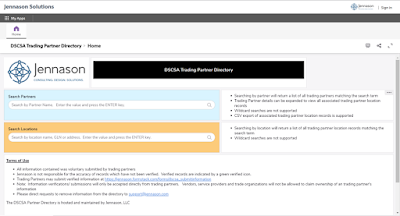
Jennason DSCSA Trading Partner Directory

Jennason is releasing the DSCSA Trading Partner directory to alleviate the inefficient processes currently required to exchange basic trading partner information as part of establishing DSCSA connectivity.

The Trading Partner Directory is accessible to all users and relies on voluntarily submitted information from industry entities (Manufacturers, wholesalers, dispensers).

The directory allows users to search by partner name, GLN or address and returns trading partner information including name, GLN, address and location type (Sold From, Sold To, Ship From, Ship To).


When information is submitted by an entity it is reviewed by Jennason and requires a secondary verification from the submitting organization before being viewable in the directory.   All verified information is indicated by a green icon.

If you are interested in submitting your entity’s details to the directory please visit https://jennason.formstack.com/forms/dscsa_submitinformation and complete the brief survey.

Once your information is published in the directory, all future location master data requests from partner's can be directed to your dedicated repository URL which provides an exportable report of your location master data records.


Jennason is currently gathering a baseline of trading partner information and plans to release the directory to the public no later than September 22.

To learn more about the importance of a centralized DSCSA Trading Partner directory listen to Episode 4 of the 'Saying The Quiet Things Out Loud' Podcast  (Minute 32:40)

https://podcasters.spotify.com/pod/show/jennasonllc/episodes/Build-It-And-They-Will-Come-e296j3d

Please direct any questions regarding the DSCSA Trading Partner Directory to support@jennason.com

Thank you for your collaboration.  With your support we can help close this simple, yet significantly impactful gap in DSCSA interoperability.

Monday, August 7, 2023

"Saying The Quiet Things Out Loud" Episode 1: A New Approach, In More Ways Than One Full Transcript


Listen to the "Saying the Quiet Things Out Loud" Podcast:" Episode 1

https://spotifyanchor-web.app.link/e/LMo8ExwP4Bb

-----------------------------------------------------------------------------------------

Hi everyone, this is Scott Pugh, principal of Jennason, LLC. I'm excited today to welcome everybody to the first official installment of the “Saying the Quiet Things Out Loud” podcast.

I'm calling this a podcast, but I will say upfront that what I hope to do through this audio approach is really a continuation of what I've done for many years through my writings and other posts on my blog at Lifescienceserialization.com and other channels such as LinkedIn, which is to focus on the pharmaceutical serialization space, but more importantly, use this as a platform to bring attention to specific topics and areas that I feel are not really getting enough attention, yet are often things that can lead to challenges, risks, issues that companies might encounter as we're all marching towards compliance, whether it be with DSCSA or other regulations.

So, I look forward to using this platform to further discussions and conversations in those areas. I hope this is a much more interactive way to connect with people in the industry. I certainly encourage everyone to provide feedback and comments. Again, my goal at the end of the day is to make sure that everybody is being educated with good information. I think it's something that's long been a challenge in this space. A lot of times what you might gather from conferences, from marketing materials and other advertisements, can paint quite a different picture than if you're actually in the depths of going through these implementations, understanding the systems and the processes and just the general capabilities that are being put in place.

I'm going to try to keep these segments rather short just so everyone doesn't need to set aside thirty minutes or an hour to listen to an episode. Hopefully we'll try to keep them more towards five or ten minutes or so. And again, each one will really focus on a specific issue.

Today in particular, I want to focus on the topic that's at the top of most people's minds, which are these recent letters that have come out from a variety of groups addressed to the FDA in regards to the upcoming November DSCSA deadline.

We've had at least three of these letters in the past few weeks. We had a letter from the HDA. We had a letter from the NABP and then we had a letter from a group of House Representatives. Again, all of these letters addressed to the FDA, and all of them, I would say, basically had the common theme of asking the FDA for more time to ensure that the industry would be ready to meet the requirements that are set to go into effect this November.

What I really want to focus on today, though, is not to dive into each of these letters and dissect the finer points of what they were proposing and highlighting some of the challenges that the industry has faced up to this point. But I really want to use these letters as the backdrop or foundation for what I think should be the critical questions that we as an industry should be asking at this stage of our DSCSA and serialization compliance journey. Because I think, right off the top, the fact that there's significant efforts and proposals being pushed towards the FDA that all revolve around asking for more time, I think nobody's going to disagree with that, right? I think anybody who's in this space is very aware that the industry has a long way to go before we could say that the full industry is truly ready to comply with DSCSA.

And I think it is important to highlight that the responsibility (of being ready) across the industry really is spread across all segments. There are many manufacturers that are not ready. There are many wholesale distributors that are not ready. There are many dispensers that are not ready. And the nature of DSCSA being a regulation that sits over a supply chain inherently requires that all segments and all entities within those segments are ready to comply, right? You have one link in the chain, so to speak, that's not ready, and it basically breaks down for everybody else in that chain.

So, I think that is an important thing to highlight. And I say that somewhat specifically because having read primarily the HDA letter, sometimes you read the HDA letter and you might come away thinking, man, this seems like it's all manufacturers' fault, right? Seems like wholesale distributors are ready to go, but manufacturers have really been dragging their feet. And again, there are plenty of manufacturers that are not ready. But at the same time, there are just as many, if not more distributors and dispensers, that are also not ready. So, this is equally shared across all the segments.

My main focus as I read all of these letters was really on what I didn't see. What I didn't see in terms of the questions being raised or the proposals being put forward. Because in my position, I think the thing that we all should be pushing for is if we're going to go to the FDA and collectively say, “hey, the industry needs more time”, which again, I don't think anybody's going to disagree with, then what are we to do with that additional time that's given to us?

And I think this is where I really start to differ a bit from what we see generally having been put forward in the letters thus far. Because in my opinion, the answer to that question is we shouldn't be asking for more time to simply do the same thing we've been doing for the past 10 years at this point.

The way I like to describe it is if I were to have the opportunity to basically sit and down with a blank piece of paper in front of me and be tasked with designing the most efficient, most cost-effective way to facilitate interoperability between supply chain entities, in this case to support product traceability, I'm confident, I'm extremely confident that myself and most people especially those who have been involved in this space, but I think even people who have been outside the space, but at least understand supply chains, I don't think anybody would draw a picture that anywhere resembles what we've, as an industry, have tried to put in place today.

These efforts, especially over the past, let's call it, a year, 18 months, maybe two years, where many in the industry have been going off to establish all of these connections between all of their trading partners. There is no possible way that is the best way for us to go about this. I recognize on one hand, as an industry, we have to leverage the capabilities and the systems that are available to us. And for that reason, we maybe didn't have many other choices or options, but to go down this path of establishing point-to-point connections to each other. But I think if we've reached this kind of stage that we're at now, which is where we are all desperately looking to have the FDA take action to essentially provide us with more time, then the first question we should all be asking is, are we even going about this the right way? Are we even on the right path?

That's really what I'm going to be interested to watch and look for as these discussions progress forward. And it could be discussions that come about because of the letters that have been authored or undoubtedly, there's going to be additional letters coming from other organizations and other key members within the supply chain. What I'm going to be looking for is, as part of those future proposals, does it not just ask for more time, but does it recommend an approach that says as a first thing we should do once you give us more time is we should all take a step back and just determine and evaluate have we really been going about this the right way.

I do think it's important to clarify that when I say and when I give my opinion that I don't believe the industry has gone about this the right way for many reasons, that's not the same as saying I think we should all basically start from scratch again, right? That's not me saying that people should be ripping out packaging equipment systems, other serialization systems. That's not at all what is going to feasibly or realistically or should be done in this case. I think that there has been significant learnings and maturing and evolving of systems and processes related to serialization from the packaging line level through site level. Basically, everything that we've been focusing on for the past 10 years, which is managing serialization within the four walls.

I think it's once you get outside the four walls that we've completely missed the boat. Again, going back to this approach that we've adopted of creating all these connections to our partners. There's no possible way that is the best and correct way and right way to go about this. And I think unfortunately, and sort of going back to an earlier point I made I think this is also one of the prime areas where there is a complete misperception across the industry around this notion of connecting partners and how that's actually done and the different systems and capabilities that are out there to do that.

To be very, very clear, right, regardless of what any marketing material or any presentation you might hear at a conference, we don't have today in the pharma industry, the concept or something that would represent the concept of what I consider to be a true network. And probably the better term is really a true collaboration network. We have a lot of different players that are trying to position themselves as such. But the reality is we do not have that kind of capability in its truest sense in any way, shape, or form across the industry.

That would be the first place I would be recommending an evaluation, a sort of a reflection to start, right? If we are going to be granted more time from the FDA, why don't we take a step back and really say to ourselves, look, there's got to be a better way to facilitate these exchanges of data between all these entities. Because what we have today, it's just it's not there and it's not working, right? It's not a feasible, scalable, efficient, cost-effective approach to essentially put in the foundation- which is the critical foundation to really be able to achieve true end-to-end supply chain traceability.

So again, I'm really going to be interested to look for groups that take that sort of mindset, maybe make similar proposals that as part of asking for more time, we think the first step needs to be to really do that self-reflection, that self-evaluation as an industry to determine are we even on the right path.

I don't think we can ignore the fact that there's been some pretty major pharmaceutical entities, manufacturers to be specific, that have done exactly that over the past couple of years, where they basically said, look, we've been serializing now for a long time. Let's take all of this information, all of this learning, all of this experience that we've had over that time and really make some decisions about what is going to be the best way for us to move forward.  It's been widely known, you've seen some pretty significant changes be made, some of the major manufacturers across the industry in terms of how they are approaching serialization. So, if we have the major players in the industry doing that kind of reflection and coming to the conclusion that, yeah, we needed to make some changes, why wouldn't we do that same kind of activity as an industry as a whole? It just seems like logical sense.

It would be very challenging to eventually get to a place where we've asked the FDA for more time and the end result is we continue down the same path as we have been because again, my opinion, all that's going to do is we're going to get a year or two years from now, however much additional time is granted, and we're going to basically be in the same spot as we are today. We might have more companies that are “ready”, right? They've established their connections. But that's not going to have addressed the underlying concerns and issues that are already present as people have started to create these connections, right? Which are things like the quality of data is just absolutely terrible, right? The data integrity issues across the industry are extreme, to say the least. And those types of things don't just magically go away just because everyone is now “ready”. In fact, those types of issues only get more magnified as more and more people are connected and as more and more of these data exchanges start to occur. And most importantly, more and more people actually start paying attention to that data that's being exchanged. That is by far the biggest difference of what we are just now starting to enter versus really what we've had for the past 10 years. which is we did all of the work to physically serialize the goods. We did all the work to capture that information within our four walls. But at the end of the day, because the regulations up to this point have never required us to ensure that data has to be 100% correct when I now ship product to my next supply chain partner, if there ever were issues found in the data, nine times out of ten, that product is still going out the door. Right? That product, that shipment is not going to be stopped up to this point because of a serialization data issue. Post November or whenever this final milestone of DSCSA goes into effects, again, if the industry follows the regulations and if the FDA enforces the regulations, we don't have that luxury of allowing data to be incorrect, yet still allowing that product to flow in the supply chain.

And so, it's really only going to be at that point when people actually have to start paying attention and caring about this serialization data that many, many companies are going to realize, Oh my goodness, this data by and large has been wrong for a long time. That's going to be the reality for a lot of people. And that's not a prediction of what I think is going to happen. It's because that's already happening today, right? The data exchanges you see today, being just flat out wrong, information being incorrect, whether it's master data, whether it's other associated data, things being formatted incorrectly, I mean, all of these types of things- But the end result is it can lead to a data exchange either not occurring or occurring but not being correct, which again, if we all follow the law, means that product should stop at that point. That's the big concern that I have that again has nothing to do with the readiness of people being connected, but simply paying attention, even if you're one of those companies who are already connected to your partners, really starting to pay attention to the data that you're receiving or sending, whatever it might be, depending on your function. Because that's going to be the real fundamental challenges that will lead to disruptions, which can lead to drug shortages.

And which is again, the big reason why I think the very first step we should all do as an industry if we are given more time is to really do that self-reflection and try to come up with what has to be the much better way to go about enabling interoperability across the industry.

It's a fascinating topic- obviously it's going to be a topic that's clearly something top of mind for all of us, even over the next weeks and months. I'm interested to see what kind of response comes from the FDA. Clearly there will have to be a response of some sort at some point. And so, there's not going to be any shortage of topics for us to continue to dive into. And that's really why I wanted to start this podcast, if you will, because I think it's just going to be a lot of topics that I'm going to definitely want to provide my opinions, my advice, my guidance, my recommendations out to the industry, and hopefully this more audio approach will allow me to do that in an efficient manner and really get, what I think are, some key points out there to the industry as fast as possible. So, again, I appreciate everyone for listening. I look forward to taking this ride with everyone, and we'll catch you in the next episode. Thank you.


Monday, June 12, 2023

The Current State of Testing for DSCSA 2023

Next DSCSA 2023 Observation-   The resource crunch is officially on.   

A clear impact this is having on ongoing connectivity efforts- availability and support for testing

Specific observations:

  • Vendors/partners foregoing testing all together and focus instead on monitoring initial data exchanges in production
  • Resource availability across all parties (manufacturers, vendors, CMOs, 3PLs) is extremely limited or non-existent.  This is especially apparent within the 3PL segment which is critical for most manufacturers to perform DSCSA T2 data exchange with customers

The risks:

  • I understand the intention of foregoing testing- typically in scenarios where the sending and receiving vendor systems have already connected previously.    This *should* be acceptable from a technical point of view- but what gets missed completely is the range of functional testing that is needed- especially that which focuses on the exception scenarios which will be the greatest cause of supply chain distribution post November.    Manufacturers, wholesalers, dispensers are creating their own problems if they accept to forego testing.
  • We recently saw how much of a disaster master data is.  Now we are looking at the full scope of data included in these exchanges- master data, transactional data and serialization data.  The latter of which is exponentially more complex than master data-  I, for one, have no belief this is all going to magically ‘work’ without testing.   

What to do:

  • Common theme-  don’t rely solely on your vendor saying everything with partner connectivity is good because a single test was run that shows a technical exchange was completed.  This nonsense that you can ‘flip a switch’ on connectivity simply doesn’t exist.   Moreover, “my vendor told me so” isn’t going to hold up when you’re explaining to your CXO why a shipment is stopped or when an auditor asks you to demonstrate ‘control’ of your GxP serialization system.
  • Test-  Currently there are too many barriers for companies to execute efficient testing because too many companies have put themselves in a position where they are wholly reliant on their partners/vendors.  For example, some 3PLs are now quoting anywhere from 2 to 10 weeks for testing support and charging thousands of dollars per test.  That simply isn’t sustainable for now until November.   You have to be able to perform testing yourself- even without support from partners.    
  • The Jennason Serialization Test Tool (https://jennason.com/solutions) is the only solution in the industry that allows you to simulate the interactions of your partners and allows you to perform testing without reliance on vendors or partners.   For example, you can simulate outbound shipment messages from your 3PL which in turn triggers the serialized T2 to customers. All EPCIS varieties used by the major 3PLs (Eversana, ICS, McKesson 3PL/rXCrossroads, Cardinal 3PL, etc.) are supported in the tool.   

Of all the implementation phases, testing is NOT the one to try hitting the ‘easy button’.   When you don’t test, you have no excuses when issues start to occur.  Put yourself in a position to be able to do SOMETHING which is always better than doing NOTHING.


Sunday, December 4, 2022

Data Integrity and DSCSA

November 2023 marks the final implementation milestone of the Drug Supply Chain Security Act.  This final phase of DSCSA represents, arguably, the most complex aspects of the regulation- requiring the end-to-end traceability of serialized items from manufacturer through to dispenser.  

Central to ensuring the industry can meet these requirements is the ability to capture traceability data and exchange between partners as product moves through the supply chain.  This same data is also the foundation for verification processes which help the industry root out illegally diverted and counterfeit products.

Effectively then- with the implementation of DSCSA 2023- serialization and traceability data becomes as important as the physical items themselves to ensuring uninterrupted product flow and a secure supply chain. And that level of importance places a significant emphasis on ensuring data is accurate and availability- a concept the FDA refers to as data integrity.

Even putting the criticality of DSCSA data aside for a moment, the FDA has made its position on data integrity explicitly clear with the release of the ‘Data Integrity and Compliance in Drug CGMP’ guidance in 2018.  The guidance defines the ALCOA principle which requires data be “attributable, legible, contemporaneously recorded, original or true copy and accurate.” (We’ll come back to this)

In the past week we crossed a major milestone in the industry’s march towards DSCSA’s November 2023 deadline- we are officially under one year to go.  The final chapter in a 10+ year journey to build out serialization capabilities across the industry.  Understanding the importance of data, a casual observer outside of pharma would reasonably assume the industry, by this point, has expended significant resources on systems and processes to ensure the ‘ALCOA’ of DSCSA data.  Certainly the industry wants to avoid the scenario where perfectly legitimate product can’t reach patients because data is not accurate or data can’t be exchanged.   Seems like a no-brainer, right?

So how is it then, with less than 365 days to go (255 working days for those keeping track) that I can write a blog post about a data integrity issue that is so fundamental it affects most (possibly all?) customers using the supposed ‘leading’ DSCSA serialization L4/L5 system?   A data integrity issue so basic that it raises the potential of supply chain disruption and exposes impacted customers to a clear audit risk under the FDA’s 2018 guidance.

So what is the issue?  When processing critical traceability events- specifically shipping and receiving events- the aforementioned system is setting the event date/time equal to when the data was processed rather than the actual date/time of when the event happened.  In other words, this system is changing your DSCSA data based on an activity (processing in their system) that has no correlation to when the actual supply chain event happened- meaning 100% of your impacted shipping and receiving events are wrong.

Here’s an example:   Your 3PL ships a serialized order to your customer on June 4.  The 3PL sends you a data file which correctly indicates the shipment went out on June 4.      Due to [enter any one of a million reasons here] the data is received and processed in your system on June 5.  Astoundingly, your serialization system now reflects the shipment occurred on June 5. 

But Scott it’s only a day off- who cares?  If you’re focusing on how inaccurate the data is, rather than why the data is inaccurate then you’re missing the point.  A serialization system does not get to arbitrarily choose the date/time when an event happens.  It must record the date/time as provided by the source system.  Otherwise it not only fails the ‘Accurate’ principle of FDA's guidance but it also fails any measure of being a validated system and subsequently fails one of the most basic operations of any serialization system.  Moreover, the system further propagates the issue by including the incorrect date/times in data exchanges with partners which, in turn, diminishes the validity and effectiveness of DSCSA verification processes which so vitaly rely on this data.  In short, this fundamental data integrity issue endangers the core aspects of DSCSA and a flaw such as this immediately calls into question the integrity of all other data managed within the system.  

Since identifying this current issue I’ve struggled to decide which scenario is worse:

  • That an issue of this nature is truly just being discovered now- when hundreds of companies have been using the system, in most cases, for multiple years

Or

  • That the issue has been known for some period of time, hasn’t yet been fixed and hasn’t received any publicity across the industry

Either way the outcome is worrisome- either this shows a clear sign that the industry has been asleep-at-the-wheel when it comes to understanding and reviewing serialization data OR we are setting a reckless and irreversible precedent by considering this type of data integrity issue as acceptable.   

If I am a customer impacted by this issue, I am dropping everything immediately and:

  • Determining the extent of damage this has on my data
  • Determining my data integrity audit exposure risk
  • Evaluating my compliance approach to DSCSA

After doing so I would be making rapid decisions, while I still have time, to ensure my systems are capable of the core concepts of serialization and traceability data management.  And for those who feel a sense of comfort that many others in the industry are impacted by this same issue, that may not be a responsible position to take because, keep in mind, regulations and auditors don’t care if you’re 1 of 1 or 1 of a million.

As always, feel free to reach out to learn more about this issue. 

Tuesday, October 11, 2022

A new suite of Jennason Implementation Tools

Jennason Serialization Total Cost of Ownership Model-  Quickly evaluate Total Cost of Ownership across multiple vendors and multiple future scope scenarios.   The Jennason Serialization TCO model provides reporting/charting of total serialization spend on an annual basis as well as aggregated spend over a configurable period of time.   The tool also allows companies to calculate costs for future scope scenarios, such as the addition of new markets, partners and solution capabilities.  All reporting and graphs can be easily exported for inclusion in senior management presentations.  Additionally, the TCO model can be used to estimate serialization budget needs by expanding the cost items tracked to include non-system fees such as CMO/3PL partner costs and internal/external resource costs.

Jennason Data Migration Manager- For companies switching serialization providers, the Jennason Data Migration Manager is used to oversee the end-to-end data migration process- including definition of scope, source data details, data conversion and target data import details.  Additionally, the solution can automatically generate Data Migration Plans, conversion specifications and data verification protocols.     The Data Migration Manager can also be combined with the Jennason Translation Tool which has pre-built data converters allowing companies to quickly migrate serialization data from legacy systems into their new serialization platform (for example: CSV à EPCIS conversion)

Jennason DSCSA Implementation Manager- Consolidate serialization system implementation, vendor switches and DSCSA 2023 compliance efforts into a centralized, web-accessible dashboard and project management tools including integrated project plans, DSCSA resources and issues/risk management.   The DSCSA Implementation Manager can be extended directly to partners (CMOs/3PLs/Customers) to provide real-time visibility into project status, open action items and upcoming milestones.

Contact Jennason for more information and to schedule a demo.

nextsteps@jennason.com

https://jennason.com

Monday, September 26, 2022

Red Flag Notice: Is your serialization L4/L5 vendor ready for DSCSA 2023 compliance?

Understanding, planning and starting implementation for DSCSA 2023 is (and has been) the top priority for most pharma manufacturers.

We are just over 1 year out from the regulatory deadline (and nearly 10 years from the date DSCSA was passed) and some serialization L4/L5 vendors are indicating ‘new’ features/modules/portals will be required for DSCSA 2023 compliance. The vendors convey full ‘assurance’ to manufacturers that they will be compliant, but can’t provide any notable details, can’t provide timelines of when it will be ready and, most importantly, can’t commit to pricing for these ‘new’ components- that is a major red flag.

I worry many manufacturers are barreling down a path where they give their L4/L5 vendor full latitude to dictate their 2023 compliance approach, effort and, most importantly, costs but yet may not be given those details until 9/6/3 months before the deadline- likely after a point where the manufacturer can feasibly consider any other options.

What if your vendor comes back and says this ‘new’ component is going to cost a hefty implementation fee and an additional $30K+ per year?  Many manufacturers are currently in the midst of 2023 budget planning- how will you account for that?     In many ways this is the textbook definition of a mob shakedown- give your constituents (customers) assurance of safety (compliance), and then just before a known threat (compliance deadline) demand more money.

It is critical that manufacturers recognize there are other options for DSCSA 2023 compliance, and in most cases, these other options offer a lower TCO and lower risk profile then simply building point-to-point customer connections out of your L4/L5 system. (We summarize all options below)

But I’m also realistic that there are a large number of manufacturers who simply can’t comprehend considering options other than full reliance on their L4/L5 vendor (as unfortunate as this may be).  However even in that scenario- at an absolute bare minimum, and when I say ‘bare minimum’ I mean literally taking the time to send one email or have one phone call- manufacturers should be requiring their vendor lock in DSCSA compliance costs for 2023 and beyond TODAY.  Otherwise it’s your own fault if you get caught in the mob shakedown situation noted earlier.

For those that are willing to identify better approaches let’s summarize the key pros/cons:

Customer connectivity out of your serialization L4/L5 system

  • Regardless of who your L4/L5 vendor is and regardless of marketing that promotes a ‘network’ concept, every serialization L4/L5 vendor in the industry today relies on establishing point-to-point connections.  This is an extremely inefficient and archaic approach to enabling interoperability across a supply chain- yet admittedly this is the path that most manufacturers are following because they believe it to be the only option available

Again, this is beyond unfortunate. 

  • Pros:  L4/L5 vendors are experienced in establishing connections   Cons:  Costs will be higher than expected, promotes the point-to-point architecture which limits future scalability. For many manufacturers, this approach will add significant scope to their L4/L5 system which further limits flexibility and account control (account control essentially refers to the leverage a manufacturer has to dictate terms of engagement with a vendor)

Connectivity from your 3PL

  • An attractive option, especially for virtual manufacturers who have been relying on their 3PL for Lot Level T3 exchange.  While not every 3PL is offering DSCSA 2023 connectivity, this will be a popular approach for many small to medium manufacturers
  • Pros:  Often very attractive pricing, offloads responsibility of connectivity administration  Cons: Not the core competency of a 3PL, locks manufacturers in to that specific 3PL for DSCSA compliance, may limit visibility to data in manufacturer’s serialization system.

Leverage a DSCSA Connectivity Service

  • Finally after 10+ years, the industry has an option which reflects how supply chain interoperability should operate.  
  • A DSCSA connectivity service provides a true ‘connect once’ experience that also serves as the foundation for other value-add services which take advantage of a true network concept (e.g. recalls, verifications, tracing) (I can’t stress enough how different this option is compared to any current vendor marketing a ‘network’ concept. )
  • Doesn’t require manufacturers change their L4/L5 system, simply add one additional connection from the L4/L5 to the connectivity service and the connectivity service establishes connections with all downstream customers (EPCIS connects and portal)
  • Pros:  Based strictly on standards, commoditizes the exchange of data (as it should be), unrivaled long term TCO compared to L4/L5 vendor or 3PL options, provides greatest L4/L5 vendor account control to manufacturers   Cons:  A relatively new offering in the industry.

The options are there.  

The ability for manufacturers to solidify their DSCSA 2023 approach/effort/costs is in their control (for those willing to take the minimal effort). 

As always- it's on the industry to take the (smallest amount of) effort to become educated on all options and recognize the best approach is not always status quo.

Jennason is excited to be working with manufacturers taking a holistic approach to DSCSA 2023 and helping to further educate them on these options.

Monday, July 18, 2022

DSCSA 2023 Testing: A blind resume comparison

A popular sports analysis mechanism is known as a 'blind resume'.  The idea is to provide a set of characteristics of two anonymous athletes/teams and allow the viewer to guess which 'resume' belongs to which athlete/team.  For basketball fans, this method is often used in the lead up to the annual NCAA basketball tournament as a way to evaluate two teams competing for a final spot in the field.   

On a deeper level, the intent of a 'blind resume' is to demonstrate the power of perception from brand recognition. Sports fans normally have preconceived ideas about who is 'good' and who is 'bad' and, thus, when presented with a two sets of characteristics- one generally 'better' than the other- the natural reaction is to assign the perceived 'good' athlete/team with the good set of characteristics and the perceived 'bad' (or not as good) athlete/team with the 'bad' (or not as good) set of characteristics.

And for those who haven't seen a 'blind resume' play out- the correct assignment is almost always the opposite.  It's a sneaky, yet intriguing method and one, I think, applies well to the serialization L4/L5 vendor space which has long been rife with misperception as a result of marketing imbalance and, quite frankly, misleading advertising.

In particular this method can be used to show a noticeable disparity when it comes to manufacturers' ability to perform testing as part of upcoming DSCSA 2023 efforts. 

As you've heard me say numerous times before- testing is the most important phase of any serialization effort.   Testing is not only a critical phase in determining overall success/failure of an effort, but is also the phase that most directly drives the level of internal/external resource effort needed and overall cost of a serialization project.   This is because a lack of testing performed, or the inability to perform adequate testing, increases overall risk- and when risk increases, the likelihood of exceptions/failures, including very costly exceptions/failures, increases as well.

So the key message is that all manufacturers need to plan for extensive testing as part of DSCSA 2023 efforts and must take steps to ensure this testing can be performed efficiently and cost-effectively.  

Interestingly, simply looking at who your serialization L4/L5 vendor is plays a major part in determining your ability to test. Enter the 'blind resume'... Good Luck!!


Remember the rule: Manufacturers who don't test or can't test increase their risk.  And those who simply 'trust' their vendor to perform all necessary testing will experience this- https://www.lifescienceserialization.com/2022/06/we-can-do-better-than-this.html -sooner rather than later.

I encourage everyone to leave their guesses in the comments!!  And feel free to reach out to Jennason for the blind resume answers and to hear more about our experiences testing against all serialization L4/L5 vendors.

Tuesday, July 12, 2022

A baseline for serialization L4/L5 pricing

Pricing of L4/L5 serialization systems has been a roller coaster over the past decade+.  The earliest adopters paid astronomically high fees (relatively speaking) only to see many vendors take on a 'race to the bottom' mentality during the height of system adoption ahead of DSCSA serialization and EU FMD milestones.

Unfortunately, a few factors persist which lead to wildly variable pricing- proving that L4/L5 serialization system pricing is still very much an art and not a science.

Pricing is once again a topic of discussion in the industry as many manufacturers are nearing the end of a contract term with their serialization vendor.  As such, the intent of this post is to offer a 'baseline' pricing scenario which manufacturers can use to assess whether they are paying market rates.

A key disclaimer:  Vendor fees is only one factor in the total cost of ownership of an L4/L5 serialization system.  Manufacturers who find themselves paying relatively low fees may still have a high total cost of ownership if they require significant internal resourcing to support the system, rely heavily on external resources to support the system and/or rely heavily on expensive vendor support resources.    

And to tease the topic of an upcoming post-  While system fees, of course, directly contribute to long term total cost of ownership (TCO), arguably, equally important to long term TCO is risk.  High risk with a serialization system increases the possibility of exceptions- and in the serialization world exceptions can mean product stops flowing and patients are at risk- in short- scenarios whose 'cost' can be business-altering.  Many manufacturers have justified paying higher vendor fees in return for having the perceived lowest risk (and lowest total cost of ownership) solution.  Unfortunately, in Jennason's experience, these manufacturers are in for a surprise when recognizing their higher cost vendor is, in fact, also the highest risk vendor.  (Much more to come on this topic)

The driver, and again intent of this post, is my belief that A LOT of manufacturers are drastically overpaying for their L4/L5 serialization system relative to current market rates.  The hope is more education will help manufacturers reevaluate and identify their best long term strategic partners or, at a minimum, give manufacturers leverage to renegotiate future contract terms.

A key challenge, historically, is that pricing has not been purely market-driven, but instead driven simply by what the customer was willing to pay.  Additionally many manufacturers are not gathering insight into current market-rates. This, in turn, creates a 'perfect storm' scenario where manufacturers end up paying outrageously high fees.

Vendors love this 'perfect storm' because it means that on any given deal, if all the factors align, they can score a big sale. 

In the industry's best interest, we need to change that.... 

Thus, in an attempt to define a 'baseline' pricing scenario for a pharma manufacturer we'll use the simplest serialization use case.   Fortunately, many manufactures will fit into this exact use case (and are many of the manufacturers who we believe are drastically overpaying).

The baseline pharma manufacturer use case:

  • 1 CMO partner
  • 1 3PL Partner
  • 1-10 downstream customers
  • Compliance for 1 distribution market (US DSCSA for example)
  • Standard data requirements
  • Standard quality/validation requirements
For this scope if you are paying at or greater than $100,000 in annual recurring fees, you have an opportunity to reduce costs, conservatively, by 30% on annual basis and potentially as much as 60%. If you are paying significantly more than $100,000 in annual fees for the scope above, red-flashing alarms should be going off.  

In those scenarios, manufacturers may be able to absorb the fees which come with making a system change  (e.g. new system implementation fees, project fees from CMO/3PL partners, external support fees) and still realize a positive ROI within the first 2-3 years of their new contract.

For manufacturers, the window to solidify long term, strategic serialization vendors is now.  With the upcoming DSCSA 2023 implementation efforts, significant scope will be added to many manufacturer's serialization systems.  Thus, for manufacturers who have concerns about their current vendor, it's in their best interest to do a long term, strategic vendor evaluation first and then dive into 2023 efforts. 

Thursday, June 23, 2022

We can do better than this.....

This is the level of service from a ‘leading’ serialization L4/L5 vendor that the pharma industry deems acceptable.   

  • Manufacturer’s CMO and 3PL integrations are operating as expected.   No changes to data/ no changes to configuration are made
  • Manufacturer gets a call from their 3PL that data was not sent for a shipment that has just arrived
  • Manufacturer starts to investigate and finds that recent serialization data from their CMO is not being communicated to the 3PL.  Manufacturer opens support case with L4/L5 vendor
  • Manufacturer gets charged thousands of dollars by their 3PL due to not being able to provide serialization data on time
  • L4/L5 vendor takes over a week to determine that the root cause was due to a ‘fix’ for a defect they released as part of a previous version upgrade
  • Issue was never identified by the L4/L5 vendor because their internal testing doesn’t cover customer specific setup/configuration
  • While the issue is being investigated, the manufacturer has to hold batches from release so as to not incur additional late data fees from their 3PL 
  • L4/L5 vendor informs Manufacturer that the timing to make a ‘fix’ to resolve the issue caused by the earlier ‘fix’ is unknown.  Instead L4/L5 vendor directs manufacturer to make changes to their system in order to correct the issue.  
  • Manufacturer has to log a quality event internally to document the impact to product supply and justify the system changes.
  • Manufacturer makes changes and as part of quality procedure must test the changes.
  • L4/L5 vendor informs Manufacturer there is no technical way for the Manufacturer to test changes themselves- thus the manufacturer is forced to request testing support from the CMO
  • CMO charges manufacturer over a thousand dollars PER TEST      (Curiously the L4/L5 vendor of the CMO is the same L4/L5 vendor as the manufacturer)

End result- Manufacturer is out thousands of dollars, hours of internal resource time spent troubleshooting, supporting and authoring quality documentation and experienced a disruption to product flow.  All for an issue originally caused by the L4/L5 vendor which was completely avoidable.

With any other vendor 

  • the manufacturer would have had control over releases- allowing for standard quality activities to be performed that ensure proper qualification within the manufacturer’s specific setup/configuration/deployment.    
  • the manufacturer would be able to test any-and-all changes themselves, rather than be forced to engage in extremely costly support activities with their partners

Manufacturers desperately need to recognize how unsustainable this ‘status quo’ is going forward as everything ramps up to new levels (e.g. more connections, more complexity, more use cases, more exceptions). 

Pharma industry- It doesn’t have to be like this. Demand better.   And if things don’t improve- then make changes- as we’ve seen recently the biggest pharma’s recognize the need to make changes- you can do the same. 


Friday, January 7, 2022

What manufacturers face in complying with DSCSA 2023 data exchange requirements

It’s shaping up to be an interesting year for pharma manufacturers in their preparation for 2023 DSCSA compliance.  There are several components of the 2023 milestone that will require manufacturers to carry out serialization projects ahead of the deadline- and many of those projects will need to occur this year (2022) to meet industry expectations.

Central to the 2023 requirements is the need for the data exchanges sent upon the sale of drugs to include serialization data.    To date, these data exchanges (often referred to as T3s) have contained lot-level information only and have been accomplished via a combination of EDI messages (ASNs) and portals.

As highlighted in previous posts, the 2023 milestone represents the time when the pharma industry will need to enable data integration across the entire supply chain.   The approach identified in the US is to establish point-to-point connections between all responsible entities. (e.g.  a manufacturer needs to ensure there is a mechanism to exchange serialization data with each of its downstream customers)          

Many manufacturers, especially virtual manufacturers, may be in for a shock when realizing the level of effort they’ll need to expend to establish these point-to-point connections.   Why is this?

To date, many manufacturers have had the luxury of relying on their 3PL partners to establish and manage data exchanges with downstream customers (e.g. T3 exchange). These services have been provided by many 3PL’s as part of standard serialization support packages.

But, as noted, come 2023 these data exchanges need to transition to serialized exchanges and we are now starting to see some clues as to how 3PLs plan to offer support.  Unfortunately many manufacturers have learned, or will soon learn, that their 3PL will not support exchanging serialized data directly with downstream customers.  In those scenarios, that means the responsibility to establish and maintain connections with all downstream customers falls back on the manufacturers. And because the industry has aligned around the use of EPCIS to facilitate the serialized data exchanges, all of the connections established using EDI for Lot level T3 exchange won’t offset any of the effort that will be needed.  This will result in a significant undertaking considering many manufacturers may have dozens of (or more) customers.

So what are the next steps for manufacturers?

  • Set up time to discuss DSCSA 2023 with your 3PL(s) ASAP.   

A survey of the leading 3PLs in the US reveals the following range of approaches:

    • Some 3PLs are planning to support sending serialized T3s directly to downstream customers AND will make the data available to the manufacturers as well- essentially extending the service they currently provide for Lot Level T3s
    • Some 3PLs will give the manufacturer a choice- they can either send serialization data directly to the downstream customer -OR- they can send the serialization data back to the manufacturer- but they won’t do both.
    • Some 3PLs are not offering the option to send serialization data to downstream customers and will only send the serialization data back to the manufacturers- putting the responsibility fully on the manufacturers to establish the downstream connections. 

Interestingly enough, I can’t blame those 3PLs for distancing themselves from supporting the direct exchanges with customers.   The amount of connectivity that needs to be established over the next 2 yrs is such an exponential increase over what’s been done across the industry to date, the 3PLs recognize that it will result in an exponential increase in issues and problems- and they simply don’t want to have full responsibility for that.   Can’t blame them.

  •  Understand the impacts to your existing serialization vendor contract

Many manufacturers were fortunate that during the initial implementation of their serialization system the vendor did most of the heavy lifting to establish connections to partners and provide quality/validation documentation. What was often overlooked is that many vendor contracts set limits on the number of partners they will connect and/or the contracts define fees for establishing additional connections.   Look for yourself-you may find ‘small print’ that notes the vendor included the first 1 or 2 or 3 connections, but after that the ‘heavy lifting’ becomes the manufacturers responsibility. 

Again, many manufacturers may be in for a shock when they are presented with increases to their annual recurring fees (to cover the additional connections) as well as new SOWs to provide resource support to establish the new connections. (since many won’t have planned to have the internal resources to do the ‘heavy lifting’ themselves) 

  • Identify the level of effort needed to ensure 2023 compliance and look for ways to minimize the impact to your resources 

Regardless of how your 3PL plans to support serialized data exchanges, manufacturers should recognize some level of resource impact will always fall back on them.  The scope of impact, of course, depends on the 3PL’s plans as well as the level of support provided (or you choose to have provided) by your serialization vendor.    If your 3PL and serialization vendor take on most of the work, then your internal resource impact may be limited to typical document reviews and ensuring validation alignment.  However, the manufacturer will always be on the hook to perform a level of testing to ensure each of the individual connections is working as expected. 

Alternatively, if your 3PL does not plan to support direct exchanges with downstream customers and/or your serialization vendor won’t do most of the ‘heavy lifting’ (or wants to charge you too much) then there is a considerably greater impact on your internal resources.  In this scenario manufacturers will need to oversee the projects to establish connections with each of your downstream customers (even with your vendor involvement).  And while these projects will have synergies in terms of their structure and approach, at a technical level, configuration and testing steps will have to be done individually for each customer. 

Thus a common theme is the need for manufacturers to execute testing in support of establishing these downstream connections.  And the level of testing required (regardless of the scenarios noted above) should not be underestimated.  

  • Consider a minimal need to generate multiple test batches to verify each individual customer connection- and that assumes testing for each connection is successful first time ( 😊 )  
  • Additional test batches will be needed to re-test any failures as well as test any required exception scenarios. (exception handling will be the single greatest cause of headaches over the next 2 years-  the ability to cover a broad range of business scenarios and production-like volumes is the only way to uncover these exceptions)   
  • So a manufacturer who has just 10 customers is looking at 20-30+ simulated test batches, each (likely) incorporating varying products, packaging configurations and all requiring unique test serial numbers. (The more realistic # of test batches needed by most manufacturers is certainly much higher)
  • The options for manufacturers to facilitate all of this testing is limited. 
    • You can ask your CMOs to simulate test batches and some may agree- but the timeliness, flexibility and scalability is out of our control
    • You potentially can leverage your serialization vendor’s UI to simulate batches on a small scale- but this quickly becomes laborious when numerous aggregations and any level of realistic product volumes are required.  Even on a small scale, depending on all set ups required, it may take an hour+ to execute a single test.
The better option is to leverage a simple automated testing tool purpose-built for pharmaceutical serialization projects.   Watch the following brief demonstration on how the Jennason Serialization Test Tool (https://www.jennason.com/solutions) can reduce your testing time to a matter of seconds and give you full control to cover any testing scenario and volume levels required.   In addition to saving you time and money, the tool also generates barcode reports (1D and 2D barcodes corresponding to your simulated serialized shipments) that can be shared directly with your 3PL and downstream customers to better support their testing efforts.  In short, everyone wins.

Commercial details (https://www.jennason.com/shop) are shared during the demonstration as well as options for leveraging the solution as a service combined with Jennason’s advisory consulting. 


Tuesday, December 29, 2020

EPCIS woes continue.....

Another day…another woefully non-compliant EPCIS message supported by some of the ‘biggest’ players in the space.  Most will say  “Hey Scott, lighten up, it gets the job done so who cares if a few things here-and-there are not compliant”     

So as a year-end message I’ll get back on my soapbox again-   The reality is most of these ‘infractions’ (except the last one discussed below) likely don’t have a material impact on how the EPCIS communicates the necessary information from point A to point B….  the real risk/concern is this is yet again just one small example in an absolute ocean of examples where the industry is not just lax in its attempts to strictly adhere to EPCIS but is fully welcoming of it.

I’m not some private investigator with special tools that can detect these issues- I’ve praised/linked to the FREE tool that will reveal most of the issues below in a matter of seconds (https://epcisworkbench.gs1.org/ui/home)….so this can’t be about it being too hard to root out non-compliance…its simply that:

1) To this point, there hasn’t been an overwhelming reason to be air-tight on EPCIS compliance-   No EPCIS police to come around and stop product from flowing and not nearly enough interconnectivity across the industry for these issues to start causing bigger issues.

2) It’s hard to push back when some of the ‘biggest’ players in the space are the ones openly generating non-compliant EPCIS and/or willing to accept non-compliant EPCIS

Previously I’ve raised the notion of one simple way that non-compliance with EPCIS directly impacts the industry:

Take the last issue highlighted below.  Its black-and-white- both entries are simply not compliant.   But it’s happening out there in the wild (which by the way I would be interested to know if either the sending or receiving vendors are ‘certified’ by an EPCIS conformance testing service) which means the system generating this EPCIS was built in such a way that allows that to happen and, even worse, the system receiving these messages either A) didn’t catch these as issues and/or B) was built (and even possibly ‘enhanced’) to support receiving these messages.   The development it takes to support not only compliant EPCIS but now also the ocean of non-compliant EPCIS costs money.  And do you think the vendors just eat those costs?  Of course not, it goes back on the industry through increased annual fees or baked into some new ‘module’ that will be marketed.  

Now extrapolate that out over the massive number of ‘connections’ that have to be put in place by 2023 for the US market to achieve compliance.    If every vendor can go off and define what they feel is acceptable use of EPCIS then it’s the pharma industry who ultimately feels the pain.

In this space, 2021 will be the year of collaboration (or non-collaboration depending on how it plays out).   The technical issues below are likely viewed by many (not me) as minor, but what needs to be in focus is whether the industry maintains the mindset that’s been attached to EPCIS compliance…. There should be no ‘minor’ or ‘major’ non-compliance- it needs to be black-and-white… you’re either compliant or you’re not….and unfortunately, we are long past the point where non-compliant practices have become the norm.

I wrote a blog post nearly a year and a half ago that pondered whether EPCIS had lost its value as a standard within pharma serialization….  Instances such as below would seem to indicate nothing has really changed….and I still think we are just at the tip of the iceberg when it comes to understanding the impact that these seemingly insignificant and incredibly detailed ‘misses’ will have when trying to accomplish end to end traceability in pharma.

My last few posts have focused on the need for the industry to do a reality-check on whether we are moving forward with serialization/traceability in pharma in the best way possible.  Non-compliance with EPCIS is yet another reason why this reality check is needed.

----------------------------------------------------------------------------------------

Note: X’s are mine- used to preserve confidentiality


Thursday, November 12, 2020

Quick Thoughts on HDA's EPCIS Implementation Guidance....

Quick thoughts on the EPCIS implementation strategy released by the HDA in September... (https://www.hda.org/~/media/pdfs/government-affairs/position-statements/2020-09-29-getting-ready-for-epcis.ashx)

Few important highlights for me, with one being especially timely given my last post regarding the necessity for options centered around open governance industry networks.

Currently, EPCIS is the only internationally recognized standard that will meet these DSCSA requirements. 

Always good to to see the commitment to standards and specifically EPCIS.   Yet still amazing how many current connections across the industry (and even new connections continue to be established) which either do not use EPCIS or use a non-compliant EPCIS structure.

An additional complicating factor is that given the many supply chain entities that must meet the DSCSA’s 2023 requirements, competition for the services of the limited number of experts and consultants to advise on EPCIS execution will be keen. We anticipate a very high demand for this expertise -- potentially limiting trading partners’ ability to obtain the timely help they need just as they face the DSCSA’s critical deadline.  

Of course as a consultant myself I have to biasedly agree with this.     But, in my opinion, the real importance of this statement is not that I'm going to be busy the next 3 years, but rather what am I going to be busy doing?    My guess is most people read that paragraph and think "Yea think of all the connections that have to be set up between every manufacturer and their wholesalers and the wholesalers and pharmacy/hospitals.   Yikes that's a lot of work!!!"

And in fact that's exactly where the HDA guidance continues to....

At the outset, the bulk of this implementation will center on each manufacturer achieving successful EPCIS data exchange with each of its wholesale distributor trading partners. 

We encourage each pair of manufacturer and wholesale distributor trading partners to work together to establish a joint implementation plan for EPCIS execution that builds in adequate time for putting the necessary infrastructure in place, evaluating data quality, onboarding, testing, and stabilization.

And here is where my opinion starts to diverge...

The statement above sends a very clear message to the industry that we will follow the same path as we've been on for the past 10+ years...spending the dollars and resources to set up connections between each partner.   As I said in my last post- if that is the direction the industry chooses to go then c'est la vie.   I wish the guidance here wouldn't explicitly assume that's the best path forward....

My central point is-  We will have missed the boat again if we spend the next 3 years setting up integrations between each trading partner.   Those dollars and resource time should instead be allocated to deploying an open, industry governed collaborative network  (and no, despite whatever claims might be made, none of the traditional solutions/vendors fit this mold today).    Take the learnings from the last 10 years- recognize the good parts but also own up to the bad parts- and simply just look to improve over the next 3 years...staying on the same path isn't improvement....   As stated in my last post- that's the industry's call to action.....   

But there also is a call to action for solution providers.....   In HDA's defense, it would have been hard to even make reference to an open industry network in this guidance because, frankly, we havent heard nearly enough about them yet..... The messaging is starting, as we saw from the Linux Foundation announcement last month, but we need more info, more education and more tangible understanding of exactly how such a network operates and can meet the needs of 2023.... and we need all of that ASAP.

My view is, at a bare minimum, we at least owe ourselves the time/effort to more deeply consider the open network concept before assuming its not an option at all....So while I fully agree that it will take a lot of work to achieve 2023 compliance I hope that work is focused on the right efforts...


Popular Posts